Showing posts with label cosplay-tips. Show all posts

Wednesday, May 9, 2012

Cosplay Safety - Planning

This Article is part of the
Cosplay Safety Project
Arguably the most important step in creating a costume, not just in terms of safety, is the planning stage. Here is where you decide how you are going to construct the garment(s) and accessories that will make up the costume, and what (if any) changes need to be made to the design. Now, in a culture where degree of detail and accuracy is so highly praised departing in any way from the original source material may seem counter-intuitive, but it is actually quite common and accepted – when done well and for the right reasons. Two dimensional drawings don't have to adhere to the laws of physics like a three dimensional garment or prop does. Furthermore, not all of us have the same body type as the characters we choose to portray, especially if said character is not human. Really though, there can be any number of right reasons to take “creative license” when creating a fan costume, any of which will be more or less accepted by the greater community. The point is, it's you're costume and you should be able to make it however you please (though I personally argue you should always have a distinct reason for making a change...but I'm getting off topic).

Sometimes design changes must be made for a matter of logistical safety. Most often these are cases of very large aspects that would be difficult to handle at full scale. For example, were someone to create a full scale replica of, say, Sephiroth's wing it would first take a great deal of strength to balance, second not likely fit through doorways, and third cause a hazard for those walking around nearby. That is not to say seeing a full scale wing wouldn't be impressive, but we need to remember that convention halls are not a controlled environment. We have no idea what will be going on around us or how crowded the space will be, though I usually assume the worst case scenario of hyperactive teenagers running around in a densely packed crowd. If you are really dead set on creating a full scale replica of something large, I would suggest using it in a private photoshoot somewhere other than a convention where you have more control of the surroundings, and if you wish to wear the costume at a con simply make a smaller version of the large part that will be easier to manage.

Another area you want to look at, besides large parts of your costume, are the shoes. Some of the more intricate or ornate footwear found in cosplay source material is incredibly impractical. Remember that anything worn on your feet will need to bear not only your weight but that of your costume as well. Take care with any sort of platforms or high heals that the weight is distributed such that you can balance well, or you could run the risk of twisting or even breaking your ankle. You also want to avoid anything that will cause serious blisters, or else add padding to limit irritation. Don't forget to include comfortable soles if at all possible, as this will help against fatigue if you are on your feet the whole day as many of us are apt to be at conventions.

Equally as important as any design choices is your choice of materials. This will be partially informed by the source art, but you also need to consider the environment you will be wearing the costume in and what effect it's comprising materials will have on your body. For things like armor or prop weapons you should should choose based on weight and durability, finding the lightest material you can possibly go with without hindering structural stability. After all, what's the point in having a replica of InuYasha's Tetsusaiga if you can't even lift it? Just remember that any materials layered atop each other in large quantities will increase in weight; consider making things hollow if possible.

You also need to take local temperature into consideration. This comes into play both in terms of what costumes to bring to which events, as well as what materials to make any new costumes of if you have a specific event in mind to debut them at. If you are wearing a costume at, say, Otakon, which is held in Baltimore, MD in the middle of summer, you probably don't want to wear anything made of heavy wool or non-breathable pleather or anything else that will insulate your body heat. Contrastingly, at Katsucon in Washington, DC in February (often nicknamed Katsnocon in the occurrence of snowstorms) you probably wouldn't be too comfortable in a bathing suit or silk dress. Granted most convention venues usually have good temperature control, but you don't always have the luxury of staying inside, particularly when it comes to finding the best photo backdrops.

Once you know what you want your finished product to look like, and what materials you will be using, you need to figure out what methods and tools you will use to put your costume together. There are countless options that differ more or less depending on what materials you use – far more than I can go through here. Whatever you choose to do, however, be sure to research anything new to you and make sure you follow any suggested safety guidelines.

Sunday, January 22, 2012

Real Limitations, and How to Overcome Them

As I muse over my most recent entry, it occurs to me that maybe among my impassioned views I left something out. Don't get me wrong, I am a firm believer that there is no excuse for limiting yourself because you're afraid you aren't up to the challenge, but that doesn't mean there aren't some limitations that are less within our control. I suppose I will therefore amend my statement “You can accomplish any project you put your mind to,” and instead I offer this: “With enough time and money, you can accomplish any project you put your mind to.”

I hate to bring up the “m” word, but it's true. Cosplay is an expensive hobby. First with the cost of materials: though you can be resourceful and use some less traditional supplies, things like fabric, wonderflex, craft foam, paint, and other stuff needed to construct a costume aren't always that cheap and tend to add up. Then there's the convention ticket/badge/membership/etc., which even if purchased ahead of time can run pretty steep. After that you need to consider transportation and lodging, and also food. When you think about it, a weekend at a convention can run easily over $200, and that's not counting your costume!

Note that I said these things “less within our control,” though. That doesn't mean they are completely out of our control. Careful planning (both in terms of time and money) can help a lot. Be choosey with what conventions you attend. Do you have to go to 5 conventions this year? Which ones are closest? I try to avoid anything I have to fly to, both for ease and cost, though usually I try to save my pennies and treat myself to Dragon*Con if I can manage.

Another idea: consider alternate options for lodging: do you have a friend that lives 15 minutes from the convention? Now, obviously staying at the hotel is the easiest option, but when money is tight it's not always the best. Also consider how many days you need a hotel room. Again, Thursday through Sunday is easiest, but do you really need a hotel room all Friday and/or Sunday? Then of course, as many of us already do, there's splitting the cost of a hotel room a few ways. Let me pause here to remind everyone that most hotels have a 4 person per room limit. Going over this limit puts you at risk for being kicked out of the hotel. Also, personally I have never slept comfortably in a hotel room of more than 5 people anyway, so I would discourage anything over that.

Back on course now, let's talk badges. Most conventions offer discounts if you buy early. Some even have a special deal valid only the last day of the con to buy next year's membership. There are also ways to get your badge comped or reimbursed: volunteering is the most common way, be it traditional volunteering to help run the event, special performances (like key roles in Anime Boston's CosPlot), event judging (though that is usually invite-only), or panels (check individual conventions for specific guidelines). Secondly, if you happen to write/report for a legitimate news source (blog, podcast, magazine, etc.) and you want to report on the convention you can apply for a press badge, which is usually discounted if not free – if you want to enter a contest, though, check with the convention to see if you are allowed to do so on a press badge. Some cons also offer group rates if you can get 10 or more people to register together.

So, those are some ways to save money and decrease your cost for attending cons, but I feel the elephant in the room needs to be addressed: the easiest way to help afford conventions is (if you don't have one already) to get a job. Now, this is a very personal issue that I won't go into great detail on because there is no right answer for any one person, but one idea that my be right for you is to start commissioning. If you trust your skills enough and are dedicated enough to make costumes for hire (something to be perfectly honest I cannot do) this is a great way to hone your skills and make a little extra cash. You can have stock options of what you're able to do, or negotiate each project as you're hired. You can make whole costumes, just wigs, just props, just accessories, you can have pre-made “on-the-shelf” items, you can do artwork. If you trust yourself to be motivated enough by the payoff, this is a great way to help fund your hobby, just be sure to research it somewhere or thorough someone who, unlike me, actually has commissioning experience.

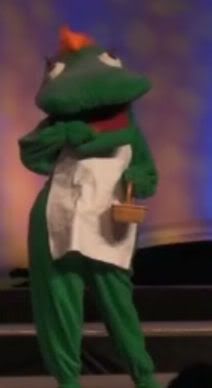
Now, to move away from the money issue (I really did not mean to talk about it at such length!), lets talk about the other major real limitation: time. Of course, I argue this isn't necessarily as strict a limitation as we imagine it to be. If you want your next costume done by your next convention and you don't finish it is it really the end of the world? No. Is it a huge disappointment and might you loose steam to get it done after the event? Probably. That doesn't mean you still can't finish it for the future, though. But let's backtrack a little bit: while I refuse to let imagined level of skill hold me back when it comes to making a costume I do use it as a factor as to how much time I need to leave. My biggest projects, like Soopy-Kun and Suzaku-no-miko Miaka, I started working on 2 to 4 months before the convention. My current major (and secret) project was stared over 5 months before the convention. If you think something is going to be difficult for you and you want it done a certain time, give yourself a big head start. Honestly, the biggest factor in ornate, amazing, difficult-looking costumes is TIME. And yes, to a lesser (but still notable) extent money.

So, to sum up: yes, there are real limitations that may hinder you in this hobby, but, as I said in my last post, whatever you perceive as your skill level should NOT be one of them! If you want to cosplay something, be it seemingly easy or hard to make, as long as you allow enough time and money you can truly make anything.

Saturday, January 21, 2012

"Who should I cosplay?"

At this point in my cosplay “career” there is no question that baffles me so much as “who should I cosplay?”--not in terms of how to answer, but why this question is even being asked. If there's one thing that happens over years of cosplaying it is your “to-do” list grows exponentially, so the idea of not knowing what to make is very foreign to me now. That said, I do remember being new to the hobby and asking for myself, “who should I cosplay?” just
Gale's first (mostly) self-made costume
(Thanks to Mom for help!)
as many other newbies do still.


But what is so different about making a to do list at the start of your “career” as opposed to years into it? My best guess is confidence. When you're new to cosplay you are unsure of your abilities and therefore feel limitations. So the question you are asking (whether of yourself or others) is not so specifically “who should I cosplay” as “what am I capable of making?” Now, granted with over nine years of experience I've also gained some confidence in my abilities, and my technique has certainly improved, but I still look back at my younger self and ask “why are you holding yourself back?”


Personally, I have always been a perfectionist. When I was younger and less experienced this led me to severely limit myself in terms of what projects I took on because I couldn't bear the thought of the end result not being up to my own standards. Now I more often just drag my heals on certain projects because I overthink them into huge daunting tasks, but ultimately get them done eventually. Or maybe that last part is just wishful thinking. Either way, I'm a lot more open to challenging myself now than I used to be, and I truly wish I had learned to be that way sooner.

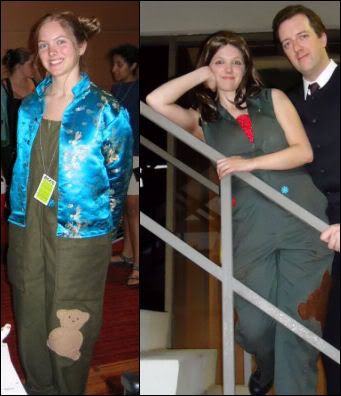
Gale's Kaylee Frye green jumpsuits
made in 2005 and 2011, respectively

The realization I had recently that I think is the most freeing is this: if you love the character enough and are disappointed in how the costume came out you can ALWAYS make the costume again. Maybe you do it immediately using what you learned the first time around for “what not to do” or maybe you wait several years until your skills have improved a bit more, either way there is NOTHING saying you can't re-make a costume. Honestly, when you think of it this is kind of a fun idea. Once you're done with version 2.0 you can look back and show off how much you've improved over the years.


I guess the point of this posting is to say to everyone out there stop holding yourself back and asking permission (of yourself or others) before you settle on what costume to make. Cosplay who you love. Cosplay who you want to be like and represent. Don't worry about your skill level or whether or not you look like a character (unless making yourself look like them causes a moral dilemma) or how popular the series is. Cosplay is about having fun and becoming someone else for a little while. Don't overthink it. Instead of asking yourself “who should I cosplay?” ask yourself “who do I want to cosplay?” then ask “how WILL I make this costume?” and then go research. You might surprise yourself with what you're able to do.

Also see my follow-up post to this: Real Limitations and How to Overcome Them.

Sunday, January 15, 2012

Packing: What Not To Forget

There are some things that without experience you just do not think about – and even then with experience you sometimes still forget! Here's a list of items I have often forgotten over the years when packing for cons. Some are rather minor, but others can cause some difficulty and annoyance if missed.

Enough Money for the Weekend
The thing about ATMs is, they're only restocked on banking days. This means holidays and weekends, which are what most convention days are, if the ATM runs out, it's out until the next business day. For this reason it is very important to plan out how much cash you are going to need to get you through the whole weekend. If you're driving, don't forget to factor tolls into that, and be sure to check if/how parking in the area needs to be paid for. Also think about food. Unless you know for a fact a place takes credit cards, plan to be buying meals with cash. Same goes for anything you might want to buy in the dealer's room. Finally, make sure to arrange how the hotel payments will be squared up: if it's during the weekend and you owe money, set that exact amount aside in an envelope so you don't end up accidentally stiffing your roommates.

Non-Costume Clothes
For a lot of us, the big focus of attending conventions is to cosplay. Realistically, though, you might not want (or be able) to spend the whole weekend in costume. What if your friends want to go off site for dinner and all your costumes are a bit too outlandish for public? Or what if something breaks/rips, or just is too uncomfortable for such long term wear? Or, simply, what if you just don't feel like wearing a costume (I know, perish the thought)?

The point is, there have been cons I've been to where I cause myself problems by underpacking on “civvies” or non-costume clothes. Another big thing I need to impress upon you is, whether costumes or not, PLEASE don't wear just one same outfit all weekend. This is a major way to contribute to “con funk” even if you are showering (and you better be showering). If you just have one costume, this means taking breaks and wearing civvies. Alternately, bring a couple costumes and alternate throughout the weekend.

Appropriate, Comfortable Footwear
Now, obviously this isn't always possible when you are cosplaying (Though I caution you to try and find/make cosplay shoes that don't eat up your feet if possible), but when it comes to walking around out of costume do not forget footwear! Trust me, I tried to get by at Dragon*Con doubling my cutesy flats from Coco Berry for my out-of-costume shoes and gave myself quite the blisters walking around. Of course, for an event as spread out as D*C this is more of a concern, but even if you don't have a far distance to go you may end up walking farther than you think just going back and forth through the convention halls.

Make-Up Remover
If you're going to be in costume, you'll want to have make-up on. But what happens at the end of the day when you're ready to go to bed? Depending on your skin type, leaving make-up on can cause acne flair ups. Even if your skin isn't so delicate, left-on eye liner and mascara is notorious for smudging overnight and without make-up remover you can rub the sensitive skin under your eyes nearly raw just to get it off, let alone the risk of getting stinging soap in your eyes!

Furthermore, if you're using more heavy-duty make-up like body paint, you should seriously consider how you're going to get that off, because if too much is left on your hotel towels you might incur a charge for extra care in laundering them. Depending on how much body paint you use, make-up wipes can work. Or, perhaps you want to simply bring your own wash cloth and towel.
 
Emergency Repair Kit
You never know when something will need to be fixed! See my previous entry on the usefulness of and how to put together an Emergency Repair Kit.

Toiletries
You really should be showering at LEAST every other day of the convention, more if you sweat a lot or wear heavy-duty make-up. Therefore this is not so much a reminder as a desperate plea: Please bring AND USE toothpaste/toothbrush, soap, and deodorant at the very least. You'll probably want more (though the hotel should supply soap, shampoo, and conditioner) but specifically what is up to you.

Medicine/First Aid Kit
If you take prescription medicine on any sort of regular basis, this should go without saying, but if not it doesn't hurt to bring some aspirin and a few band-aids as well just in case you need them.

Final Tip: Make A List
If you're at all like me, making a list of things to do or to pack before a con may have a very calming effect. I might tend to go a little overboard, listing to the most precise details of what I need, but it does help me avoid that nagging feeling in the car I may have forgotten something, or worse getting all the way there and realizing I did. Of course, then the battle becomes remembering to list everything, but that's where the above suggestions come in.

Think I forgot to list something? PM me on facebook, or email me and I may edit your suggestion into this post!

Monday, December 12, 2011

Travel Costume Repair Kit

Sometimes when you are cosplaying at a convention the unthinkable happens: someone hugs you too hard, you move beyond your garment's movement range, or you just plain used the wrong technique and glue or a seam doesn't hold. Whatever the cause, your costume needs an emergency repair. Now, I'm not talking a little seam in the back of your boot cover that will survive barely noticed until you get home. I mean something noticeable, without which your costume isn't complete, or in some cases even wearable, or else you have yet to attend craftsmanship judging and want everything to be as nice and finished as possible.

Oftentimes conventions will have their own Cosplay Emergency Repair station somewhere, usually near where Cosplay HQ and/or judging occurs, but I don't like to rely on that. You can't guarantee they will have the supplies you need, and even if they do by the time you get there they may be out. This is why I always like to bring my own cosplay repair kit of some type to any convention or major costuming event I attend.

First off you will need your basics: hand needle, thread (at least white & black, if not more), scissors, maybe some glue. These will cover most repairs you'll get caught needing. I like to take things a step further though and customize my kit for the specific costumes I'm bringing: thread matching at least my most prominent fabrics, extra buttons or beads, specific type of glue I used to adhere any major aspect (usually a hot glue gun), etc. Whatever I can do by hand should a repair be required.

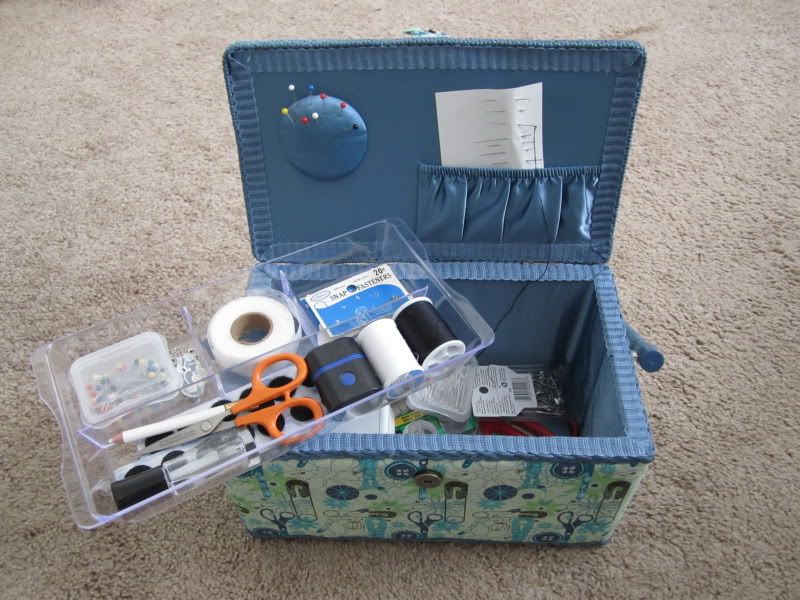
For example's sake, here's what I currently have right now in my hand sewing/emergency repair kit:
My Repair Kit
  • Several hand needles
  • Container of Pins
  • Small sewing scissors
  • Thread- Black & White
  • Needle threaders
  • Snap Fasteners
  • Hooks & Eyes
  • Velcro Dots
  • Marking pencil
  • Pencil sharpener
  • Measuring tape
  • Clear nail polish (for runs in nylons or tights)
  • Stitch Witchery fusible bonding tape
  • Wig Pins
  • Quick Dry Tacky Glue
  • E-9000 Glue
  • Safety Pins
  • Scotch Tape
  • Paper scissors
  • Hand Sewing book
  • Mini First-Aid kit

I will also tailor my kit to what space I have. If I am taking a car to the convention I'll bring a whole big toolbox of supplies. If I am flying and need to conserve space in my luggage I'll take a much smaller container with fewer, more specialized items. Sometimes I combine my repair kit with my hair supplies (copious amounts of bobby- and hair-pins, elastics of varying size and color, comb, wig brush, wig cap, etc.) to save space. What you most likely may need is a judgment call you will have to make for yourself, and after all if you do need something you don't or can't bring you can always seek out the convention's Repair Station or help from a friend or kind stranger. For my stress level's sake though I like to save that as a last resort.

Basically put, I encourage you to do a reasonable amount of planning before your weekend away. Conventions are meant to be fun, don't ruin your weekend over something that could have been prevented or at least made easier with a little pre-planning.

Tuesday, December 6, 2011

How to Successfully Present an Entertaining Masquerade Skit

One of the biggest costuming event at any convention is inevitably the Masquerade, or costume contest. Many cosplayers see the masquerade stage as vital to participation in the hobby – an unfortunate misconception in my opinion. Of course, so often individuals are drawn to this hobby in order to “see and be seen,” and one is certainly seen on the Masquerade stage. The Masquerade, however, is about much more than simply being seen, it is about putting on a show and entertaining hundreds, if not thousands, of audience members. Therefore, as both a cosplayer and a career performer I implore you all, potential Masquerade entrants, to consider a few of these pointers so we can collectively raise the bar in creating amazingly entertaining Masquerade skits in the future.

A note: this article is about entering with a skit in US anime convention style masquerades. I will not cover craftsmanship here, as some people only enter as performers without having their costumes judged. I will also not cover sci fy convention style masquerades or those from outside the US as I have very little experience with them and do not know how they specifically differ from the US anime cons I more often attend.

Don't enter the masquerade your first time at a convention
If you've never been to an anime convention before, it's probably a wise idea to get a lay of the land before you dive right in and enter the masquerade. This goes beyond just upping the quality of the skit you'll do, and into the issue of simply getting acquainted with your surroundings. Anime conventions can be a bit of sensory overload, especially the bigger ones, if you're new to the scene, so it's best to be more of an observer your first time out so you don't get overwhelmed. Plus, it gives you the chance to see what others do, and get an idea of what works and what doesn't, before you try it for yourself.

Have an idea before you sign up
Now, I know the idea of getting up on stage and showing off is VERY enticing, but there should be more driving you to enter the masquerade than simply “I want to be on stage.” I also understand that at some conventions space in the masquerade is very limited and you sometimes have to sign up months in advance. That, however, is no excuse for signing up before you know what you are going to do. If you don't have an idea for content, ask yourself a very important question: why do you want to be in the masquerade? If it's just to get on stage, consider some other options: cosplay dating game, cosplay chess, or other costume performance events that often cast attendees who sign up ahead of time. If it's to compete, consider entering your costume as a walk-on or in the hall contest. (See my "Tips for a good walk-on" post) If you really have your heart set on doing a skit in the masquerade, then you simply need to plan ahead and start brainstorming well enough in advance that you will have your idea formulated by the time sign ups come around.

Read the rules
Even if you've been in 100 masquerades, always look over the rules page before you submit your application. Different conventions have different rules, and from year to year these rules can change. Make sure you learn how many people are allowed on stage at a time, what your time limit is, what content is expressly disallowed, how competition divisions are defined, and any other important details that will only help you when entering and performing in the show. The rules page will also probably tell you if you are required to pre-register for the masquerade and when applications open. Keep in mind many conventions are popular enough that they may not have space left for at-con sign ups.

Be original
The more clever and original a skit is, the more entertaining it will be. Now, this doesn't mean you have to reinvent the wheel, but you should put some degree of thought into your concept, and you should NEVER directly copy something you've seen someone else do as a skit before. (That doesn't mean coincidences don't happen, of course, nor is there anything wrong with them.) If you like a concept someone has gone with before, think about how you can build upon it to make something new. I would also advise caution of staging “reenactments” of scenes from anime/games/etc; though I have seen them done quite well, this sort of thing takes a LOT more work than one might think to pull off.

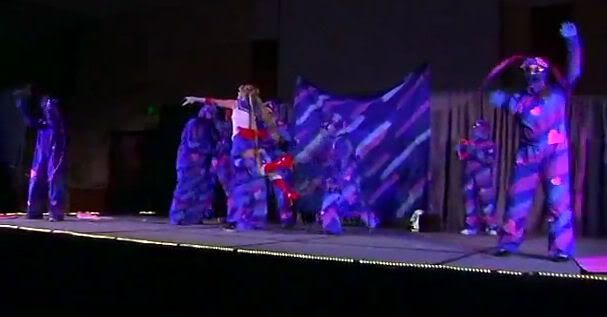
Underground Cosplay's "Henshin Ninjas"
Don't underestimate the value of Stage Ninjas
Stage hands, affectionately known in the anime community as stage ninjas, are the non-costumed performers, often dressed all in black, who manipulate props and scenery. It can be hard to work as a stage ninja--lots of cosplayers are attracted to the hobby because they want the attention, but as a stage ninja your job is to be virtually invisible. Though they may not be the "face" of a skit, stage ninjas are just as important as the leads, if not more so! They can facilitate intricate puppet and/or prop work, and some skits have been done featuring stage ninjas as the primary if not only performers.

Mind time restrictions
Due to the number of performances, most masquerades need to impose time limits on skits individual skits so that the show overall does not run too long. It is very important to keep this in mind when planning your skit. If you have dialog periodically run through the lines with a stopwatch and aim for it all to run short of the allocated time. This way you can allow for action that may pause dialog without running over time.

Some stages, like PortCon Maine's, are VERY small
Know what to expect on the stage
This may take a little work to get the information from the masquerade staff ahead of time, to be honest sometimes even they don't know this until the convention starts, but if possible it is important to find out about the space you will be performing on. Not only will it make planning your skit and choreographing your motions easier to know the size of space you'll be working on, but it could be a safety issue as well. If the stage has any levels you may have to contend with (and could trip on) or lacks anything to prevent falls you need to take this into consideration.

Limit “stock” dance choreography
There are a lot of popular “stock” dances out there, both stemming from inside and outside of the anime community, and many of them have found their way one time or another (some more often than others) to the masquerade stage. Sure, maybe you have studied and practiced the Hare Hare Yukai to the point of perfection, but that doesn't mean it is appropriate content for a masquerade performance. Consider instead running a sing & dance along panel, perhaps, or recording a video of your performance. Now, there are always exceptions to any “rule,” such as comedic commentary or original twists, however straight performances of extended portions of stock choreography almost always come off as stale and boring.

Pre-record your audio (with clear sound)
Though some conventions provide microphones at their masquerade, I strongly advise against using them. Often there are too few mics for the number of people on stage, if handheld mics are available at all, and if you don't practice with or know how to use mics the audience may not be able to hear you. Other concerns are keeping under the time limit and how having a microphone stuck in your hand the whole time will hinder your ability to act. Nowadays most computers come with a built in mic, and if you don't have your own mixing program you can get a free download of Audacity, an easy to use audio mixing program. When you record, try to get as clear a recording as possible. Try to record someplace without too much background noise and also remember to enunciate. It might help to speak more slowly than usual too. There's nothing worse for an audience than watching a skit you can't follow because you can't understand the audio. Also, when you mix everything together don't forget to allow time for actions to happen as well.


Practice, practice, practice!
Dead Moon Circus practicing
choreography before the con
I cannot stress this enough. Seriously, if you are going to do a skit you need to practice ahead of time before the con. The more involved the skit, the more and longer you need to practice. This specifically includes anything involving dance, martial arts, puppets, or any other sort of choreography. When we did the “Dead Moon Circus” skit for Anime Boston 2009 we rehearsed several times over the course of 4 months to be ready. If your skit is dialog based, you still need to rehearse before the con as well, and don't forget to practice lip syncing to your lines as if you're actually speaking them. This is a deceptively difficult skill to master and makes a huge difference in how polished your skit will look.

Craftsmanship Helps
You don't have to enter a personally made costume in the craftsmanship contest, and even if you do it doesn't have to be fancy or require incredible skill, however if it is sloppily made it may detract from your skit. Even a simple costume, if made with care, can be impressive. The most important thing to remember when constructing a costume to compliment your skit, just as with your performance, is allow enough time for the finished product to come out looking clean and polished.

Finish your costume ahead of time and practice in costume!
Yes, we already covered practicing, but I feel this issue is important enough (and often enough overlooked) that it merits it's own heading. If there is anything I regret about my preparations for “Dead Moon Circus” it is not practicing in full costume before the con. Of course, our costumes weren't done until the day of the masquerade so that wasn't possible. Luckily this did not detract too much from our performance, but if I'm going to be a perfectionist about things I know I would have been better had I rehearsed more in costume.

Leave the audience wanting more
This is a great suggestion given to me by a friend, and it is so true. While this doesn't mean to leave your skit unfinished – a sense of closure and completion is very important as well – you shouldn't let your skit jump the proverbial shark either by making it go on too long. Just because you are allowed 5 minutes does NOT mean you should fill that time. Aim to make your skit as short as possible while still going through everything you want to and don't say or do anything if it doesn't really need to be said or done.

Other miscellaneous performing tips
  • Avoid turning your back to the audience unless the action serves a specific purpose 
  • Use large animated facial expressions and gestures so they read across the whole room 
  • Memorize your dialog, even if it is pre-recorded 
  • SMILE for your audience, unless it goes against the emotion or situation you are acting 
And most of all, have fun! Once you are on stage there is nothing more you can do to prepare for the moment – you're there. So don't stress about getting it right or wrong. If you practiced enough you'll be fine. If not and you make a mistake, as long as you shrug it off and keep going the audience probably won't even realize you did something wrong. Plus, if you are really enjoying yourself that will show and make your performance all the better – trust me! At the end of the day it's not about awards or what the audience thought, though positive reviews admittedly are nice, the important thing is that YOU have FUN doing something you love.

Suggested Viewing - Creative and Well Executed Masquerade Skits and Walk-Ons
These skits all exemplify certain types of performances or techniques that might inspire you in planning and preparing your own skit.


Wednesday, November 30, 2011

Tips for a Good Masquerade Walk-on

Anime Boston 2010
For those who want to enter the masquerade but don't have the time, resources, or desire to perform a whole skit, the “walk-on” competition is a great alternative. As a walk-on, your craftsmanship still gets judged, but all you have to do in the show is just walk across the stage...well sort of. You see, contrary to popular belief there is a little more involved in a good walk-on than just walking across the stage with a quick glance at the audience as you go. You need to take the time to show off your costume so the audience can really see and appreciate it for all the hard work you've done.

Especially if you are nervous, being on stage will likely alter your perception of time making things seem to happen slower than they actually do. Take a deep breath before you go out on stage and keep calm. Walk slowly and when you get to the center of the stage pose so that the audience can admire your work. Most conventions will allow up to 30 seconds for a walk-on presentation, which is actually a lot more time than you'd think. If you can, come up with a brief pantomime that embodies your character's personality while showing off your costume. This will give you something to think about and focus on and might calm your nerves a bit. Don't forget to show all angles of your costume. Remember to smile for the audience and try to stay in character if possible. If the convention allows, select a character or series related musical track to play as background music and practice walking and posing to it ahead of time without the bright lights and audience. Finally, as always, have fun with what you're doing. If you're enjoying yourself the audience will enjoy your presentation as well.

Saturday, November 19, 2011

Haters

It is a sad but true fact that once you've started cosplaying in public one thing is inevitable: your photo will end up in a public forum, and soon after all sorts of bullies will come out of the woodwork to rip you apart. No matter your skill level, weight, or attractiveness you will be criticized for poor craftsmanship, being fat, and being ugly. If heaven forbid you are too tall, too short, a different ethnicity, or a different body type than character you are trying to portray, this will be pointed out as a negative factor. It's almost bad enough I might suggest to never read the comments on a public photo of yourself, especially if you did not post it, however at some point we all get curious. It is my hope, though, that before that happens you can have a little perspective and a think skin toward such stupidity, because it honestly means NOTHING.

One of the very worst things to come out of the internet is the false bravado it gives people. Things they would never dream of saying to someone's face suddenly roll off the tongue (or fingers, as it were) with ease because they don't have to directly confront the reality that those photos are of real people with real feelings. It disconnects them from the situation so that they can build themselves up without consequences.

I've always been told that bullies are insecure or jealous of their targets. They feel threatened some how, so they put others down so they can delude themselves into thinking they're better. I don't have any sort of degree in psychology so I can't say for sure, but it sure makes sense. Chances are, that girl calling you fat is actually paranoid about HER weight even more than you, and that boy who called you ugly is jealous he can't pull off an awesome costume like yours. For every negative comment you might see, remember all the positive ones you've gotten, and remember all the friends you have who love and admire you. What should you care about what some stupid anonymous person on the internet thinks? They don't have the guts to talk to you in person, so they don't matter.

Bullies only have as much power over you as you let them. Outside of your emotional reaction, anonymous cyber bullies don't have any real way to affect your life: they don't interact with you in person, they can't influence your friends, they don't talk to your boss/teachers/etc. If you don't see what they write it's as if it was never written. That doesn't mean it never hurts, but keep things in perspective.

Bullying is a horrible aspect of our society. On some level I think it is a symptom of how desensitized we've become by all this technology. A picture is not a person, it is a picture. Pictures don't have feelings. We forget that picture represents a person, and that person does have feelings, feelings which can be hurt. I truly hope none of my readers have ever stooped so low as to put down another cosplayer in a public forum on the internet. If you have posted, or ever consider posting rude insults of another cosplayer (or heck, any person) in a public forum on the internet please think for a second. Remember this is a real person. Remember they can see what you're writing. Think about how your words will make them feel. Think about how YOU would feel if someone wrote those words about you. If you see a friend posting bullying comments remind them to think about what they're doing. As much as we can grow a thick skin and shake these things off, they DO hurt. As silly as it can sound, there really is something to be said about that old cliche: If you can't say something nice, don't say anything at all.

I hope if you ever come across someone else ignorantly insulting your image on the internet you won't take it to heart. It's not worth it.

Sunday, November 6, 2011

Patience is a Virtue

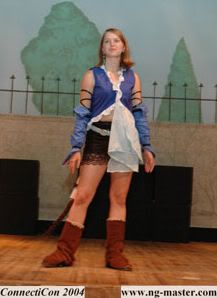
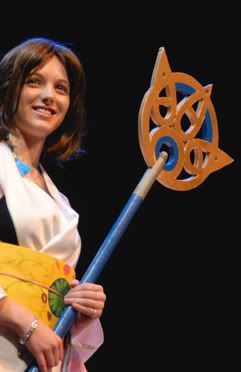
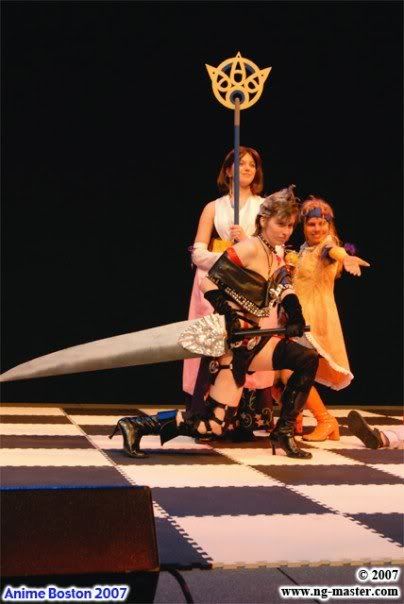
Summoner Yuna Cosplay & Staff
Photo by David Ng
One of my current projects is to fix up my old staff from my summoner Yuna (Final Fantasy X) costume. It was originally made in 2007 for the Anime Boston Cosplay Human Chess Match and consisted of foam board and an old broom stick. Unfortunately foam board is not especially durable and in the chess match it took quite a beating. Before I bring this prop out again for Anime Boston 2012 I decided to cover the foam board entirely with wonderflex to make it more resilient.

Once my new roll of wonderflex arrived I was excited to get some progress done. I traced the foam board and cut out the two main pieces. The heat gun I use when working with wonderflex, however, is technically my father's, and since I moved out of my parents house I don't have as immediate access to it. Without the heat gun I could only do so much, but I was so anxious to keep working I got a little stupid. I chose to hot glue the wonderflex to the foam board. It was a bit of a struggle to get enough glue on to place the wonderflex before some glue had cooled, but at the moment it seemed to work alright.

Fast forward a day: I've got my heat gun and start cutting out edge pieces to cover the sides and cut outs and to better fasten the main pieces together and to the foam board. Lo and behold, everywhere I placed hot glue is raised and bumpy. Had I been patient I could have tried to adhere the wonderflex directly to the foam board and it would have laid flat with ease. As it is I was able to flatten it a little with my heat gun, and will probably be able to buff out the rest of the bumpiness with sand paper, but it won't be as good as it could have been, and the perfectionist in me will always remember that.

Please, take this cautionary tale to heart and remember to be patient when you work. That is not to say put things off and procrastinate, but if you do not have the correct tools to do something and you will get them in time, don't try to make do just because you're anxious for results. Rushing will only cause sloppy results. Patience, on the other hand, will allow you to think things through and work to the best of your ability. As the old adage goes “patience is a virtue; virtue is a grace; put them both together and you'll have a happy face.” :)

Wednesday, November 2, 2011

Cosplay Goals

We may not consciously know why at the time, but everyone starts cosplaying for a reason and with a goal in mind. To really make the most of the experience though, sometimes we need to remind ourselves what we're in it for. Though some may argue certain goals are more “honorable” than others, there really is no real wrong answer to this question, and what your personal answer is might help you whenever you are trying to decide what to do next. Here's some examples of goals one might have for making a costume, and how best to see them through.

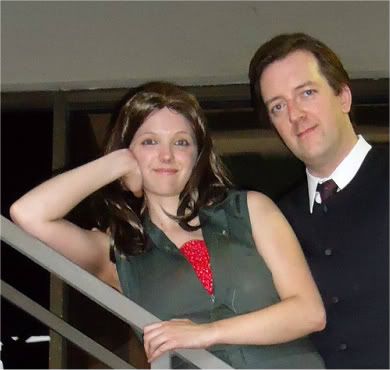
Gale as her all-time favorite character
Kaylee from Joss Whedon's Firefly
Honoring A Favorite
Be it a character, a series, an actor, a writer, or anything, one big reason to make a specific costume is because you want to honor and emulate something you love and admire. This is where a lot of us start, and where some fans are most comfortable and stay. If this is your primary goal and you aren't focused on competing you really don't even have to make your costume yourself. Find a friend or commissioner to make it, or a store that sells pre-made costumes to buy it from (just make sure you shop around for the best deal!).

Honing Your Skills
Maybe your main motivation right now is to simply better your skills. Figure out what you want to improve on, and find a costume that incorporates that. It could be a type of tool or material you've never worked with, or something you just don't have the hang of yet. Be sure to read the safety manual for all tools and don't be shy asking questions on forums. There are always people out there willing to help.

Anime Boston 2007 Cosplay Chess
Photo by David Ng
Making Friends
Every convention I go to seems to have dozens of fan-run meet-ups for popular series. This is a great way to meet people. Pick a character you can bring to a meet-up, and check out the forums (either the official forum or cosplay.com are good bets) ahead of time to see when and where the gathering will be.

Another great way to make friends is to get involved with events, such as cosplay chess or the cosplay dating game, at conventions. You can apply with a costume you've already made, or if you contact the coordinator early enough they might have suggestions of characters they really need for you to make. Just be sure you get the costume done in time for sign-ups!

Showing Off Your Work
Ok, a lot of us hate to admit it, but many cosplayers have an inner attention-whore that sometimes we can't help but let out. While there is nothing wrong with using this as a motivation for your work, I will stress that if your goal is to get attention from your cosplaying there is a right and a wrong way to do it. Nobody likes the annoying hyper kid who gets up in everyone's face saying “do you want to take my picture?” In contrast, if you put a lot of hard work into a very detailed costume, a unique and creative take on something popular, or organize a well-made large cast group you will get lots of attention and people will love you.

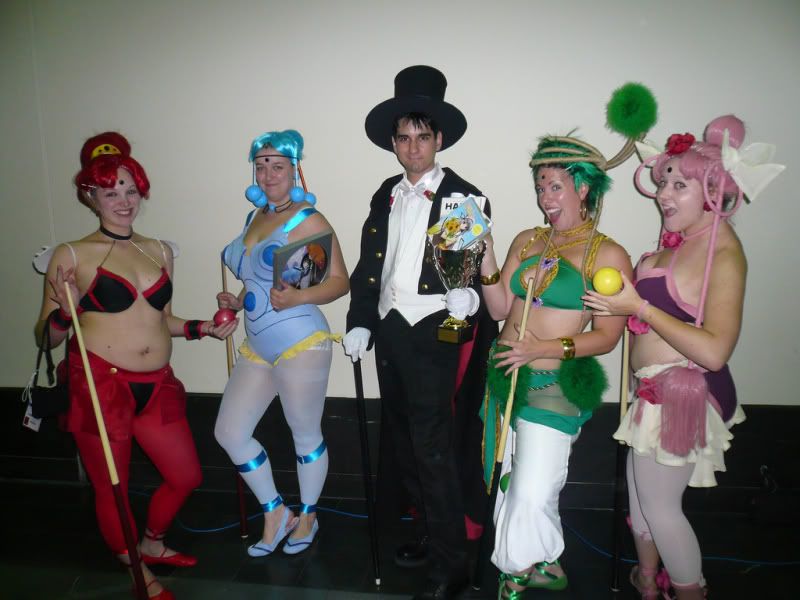
The balance is coming up with a character that is not so overdone that people won't care, but to make sure it is still known enough that people will recognize you. This is not actually as difficult a task as most people think. A great solution is to pick villains, secondary characters, or classic/old-school series characters who are very well known, but not always cosplayed. As mentioned before, of course, a well made full or nearly full cast of any series is always a hit. Some memorable groups I've seen are Tenchi Muyo, Pokemon (Indigo League), and Sailor Moon.
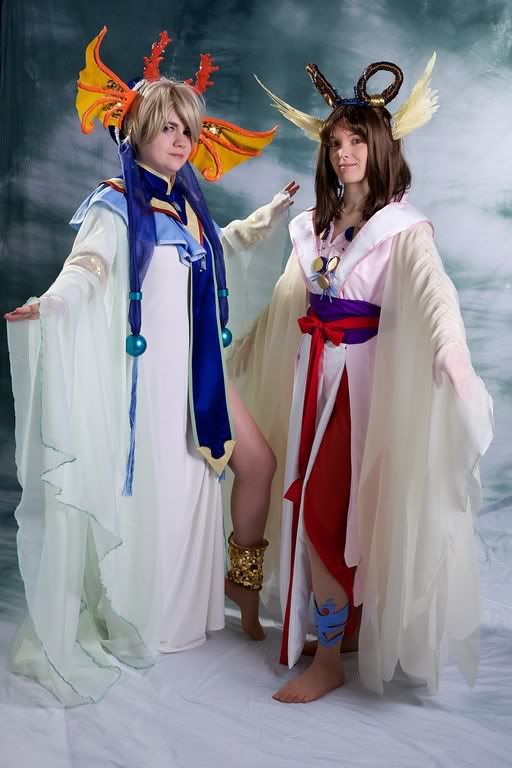
Dead Moon Circus - Best in Show Anime Boston 2009
Winning Awards
Again, a goal we don't love to admit, but sometimes this is a driving force for cosplayers. That said, if you do compete in a contest and come away empty handed it's not the end of the world and try not to take it personally. Remember to take pride in your work for what it is as well, and try to identify where your work can improve.

The key for maximizing your chances of an award winning cosplay is actually very simple (on paper, anyway): picking a detailed outfit with a reasonably high difficulty level for your skill catigory, and lots and lots of hard work. Depending on the size of the convention you are attending will dictate what the overall skill level of entrants there is like. Smaller cons tend not to be quite as competitive, however I must stress that I do NOT encourage people to take advantage of that just to get an easy award. Same goes for fudging your application and saying you're in a lower level than you rightfully should compete at. You know what level you are, don't take advantage of the system or your anonymity to get an unfair advantage.

That rant out of the way, back to how to make a competitive costume for a contest. A lot can depend on how long you've been competing and what level you are at. At novice level the first big thing to focus on is clean, finished seams. Make sure to use an iron and press your seams. Also don't forget to hem your edges, unless you are deliberately leaving them raw for some sort of effect. Once you've mastered that start working in details or techniques of higher difficulty.

If you're a journeyman, you're probably on the right track. Keep pushing yourself and trying new techniques: things like embroidery, leather-working, or wood carving that many people just don't attempt often will really give your costume an edge.

Gale as Miaka from Fushigi Yugi
Anime Boston 2011 - Photo by Ollie
At the master level if you want to win awards you have to pick costumes (and skit ideas) that are ambitious and require a lot of hard work. I usually try to start my competition cosplays anywhere from four to six moths before the convention. My Suzako no Miko Miaka (Fushigi Yuugi wallscroll) took me a total of about 80 hours spread from January to April before I debuted it at Anime Boston 2011. I read that the girls who won the hall contest that year put about 200 hours into their costumes (which were largely armor based). If you are more diligent than me you can probably get away with shorter work periods, however don't use that as an excuse to put off your work! The sooner you get it done before a con, the sooner you can troubleshoot and fix problems, or start on something new.


There are of course other goals one might have in cosplaying. I hope my few examples here have been some help, though. Figure out what your goals are and how to peruse them and it will make your cosplaying and congoing experience all the better.